Emerging Market Outperformance

Jacob Tally
There's a chart going around that might make US-only investors uncomfortable, and that's probably a good thing.
For the better part of 15 years, owning international developed market stocks (MSCI EAFE — think Europe, Japan, Australia) felt like a drag on your portfolio. The S&P 500 dominated so thoroughly that "just buy the S&P" became conventional wisdom.
But more recently, international – and especially emerging markets – are getting more attention.
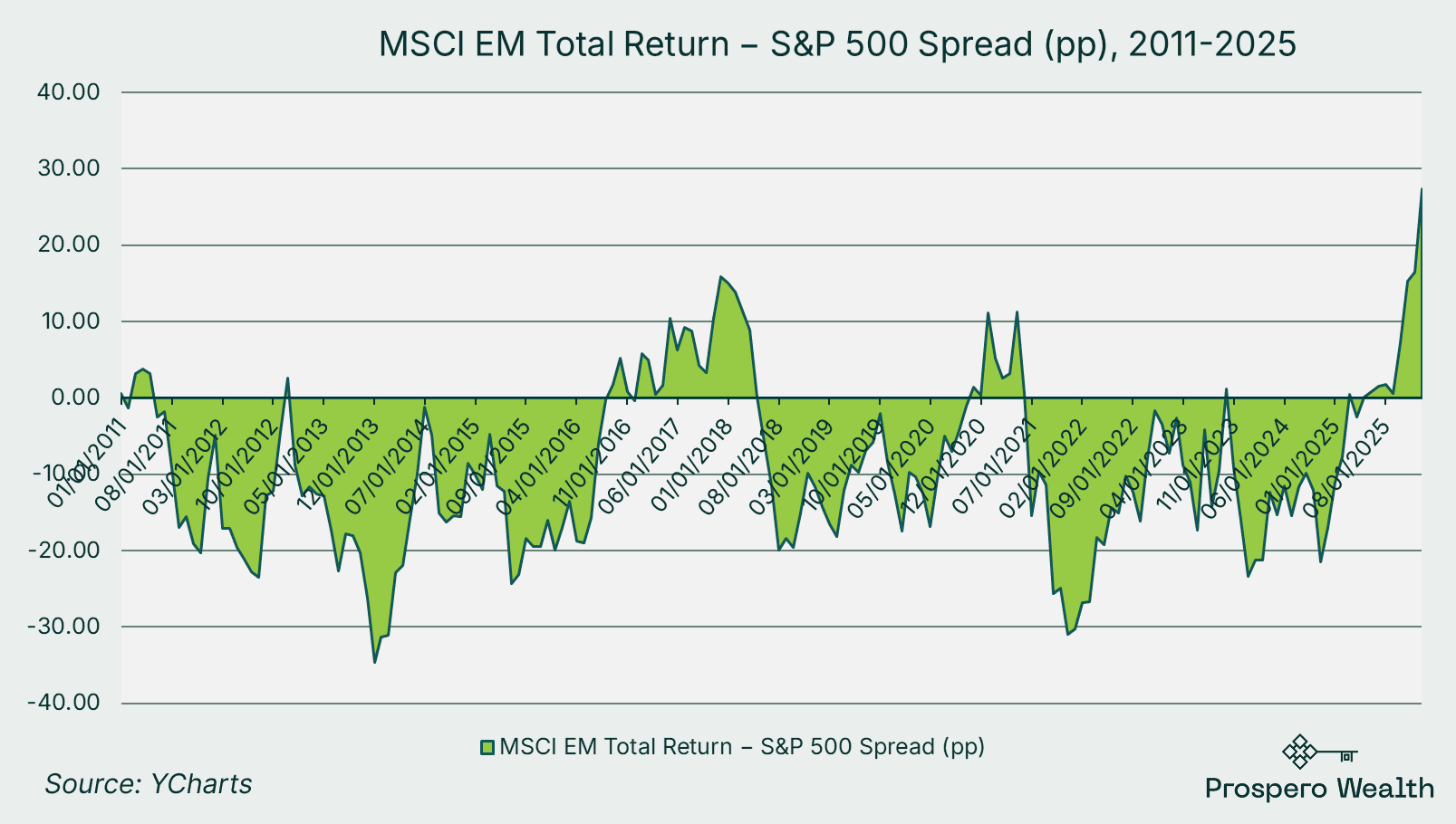
Per the graph below, from 2010 through most of 2025, EAFE trailed the S&P 500 in nearly every rolling one-year period — often by 10 to 20 percentage points. The green area almost never pokes above zero. US exceptionalism was relentless, and emerging markets underperformed as a result.
But looking at the right edge of the graph, that may be beginning to change.
That spike? EAFE just posted roughly 15 percentage points of outperformance over the S&P on a rolling one-year basis. That's the biggest positive swing in over a decade.
Now — is this just a blip? A one-off reversion that fades by summer?
Let’s zoom out.
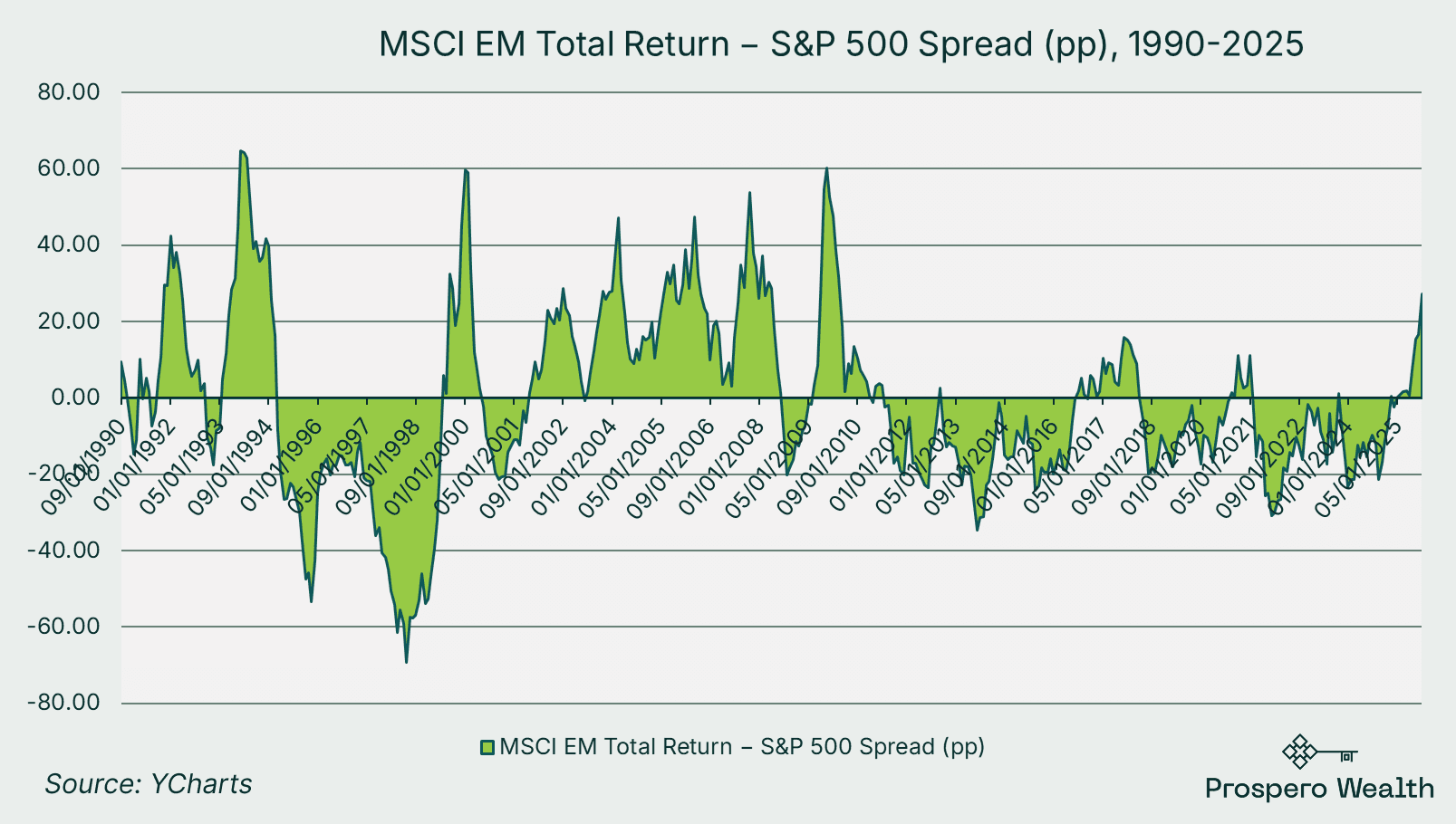
The longer view tells a different story. International developed markets led the US by wide margins in the early-to-mid 1990s and again in the mid-2000s. And these weren't one-year flashes — they were multi-year runs. The post-2010 era of US dominance was historically long and historically extreme.
Nobody can call a regime shift in real time. That's not what this post is about. But the pattern is worth paying attention to: when international outperformance shows up, it may stick around for a while.
Here's the part that I think matters most for tech professionals specifically: if you're holding a portfolio that's heavily weighted toward US large cap — and you also hold a meaningful amount of your employer's stock on top of that — you may be more concentrated in one geography and one market regime than you realize. You may be okay with that at the moment, but would you feel the same way if we see another period like 2001 to 2008?
Diversification has felt like a losing strategy for a long time. The periods where it looks the most pointless tend to be the periods right before it matters the most.